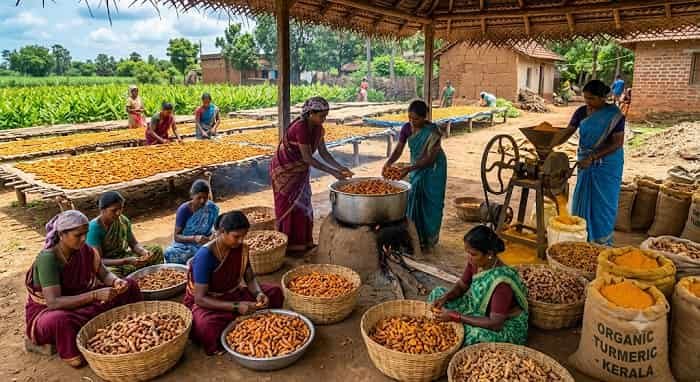
India’s turmeric story begins like a golden wave moving through red soil, black cotton fields, humid river belts, and busy spice mandis. From the bright rhizomes drying under the sun in Maharashtra to the polished yellow fingers reaching markets from Tamil Nadu and Karnataka, turmeric is not just a kitchen spice. It is medicine, colour, tradition, export product, and farmer income rolled into one crop. India remains the world’s largest producer, consumer, and exporter of turmeric, and the government has also launched the National Turmeric Board to give stronger attention to research, quality, exports, and farmer welfare.
For 2026, the latest official Spices Board figures available are the 2025–26 advance estimates. These show India’s turmeric production at about 11.37 lakh tonnes, with a few states clearly dominating the crop map.
1. Maharashtra
Maharashtra stands at the top with an estimated 3,07,202 tonnes of turmeric production in 2025–26. Its turmeric area is estimated at 87,579 hectares, making it the clear leader among Indian states.
The state’s strength comes from its large cultivation base, suitable soil, organised trading centres, and strong farmer interest in commercial spice crops. Areas such as Hingoli, Sangli, Nanded, Parbhani, and parts of Vidarbha and Marathwada are well known for turmeric farming. The crop fits well into Maharashtra’s mixed farming pattern because farmers can store and sell it depending on market conditions.
Maharashtra’s turmeric also benefits from growing demand for processed turmeric powder, polished fingers, high-curcumin produce, and export-quality material. The state is not just producing raw turmeric; it is slowly moving towards better grading, branding, and value addition. This is why Maharashtra is likely to remain India’s turmeric leader in 2026.
2. Tamil Nadu
Tamil Nadu takes the second position with an estimated 1,72,086 tonnes of turmeric production from 27,163 hectares in 2025–26.
Tamil Nadu has a long history with turmeric cultivation, especially in western and central districts. Erode is one of the most famous turmeric belts in India and is often associated with high-quality turmeric trading. The state has a strong market culture, good processing units, and experienced growers who understand curing, boiling, drying, and grading.
What makes Tamil Nadu special is not only volume but also consistency. Farmers here have better access to markets and processing support compared with many smaller producing states. Turmeric from Tamil Nadu is widely used in food, religious uses, cosmetics, ayurvedic products, and spice blends. With rising demand for clean, well-graded turmeric, Tamil Nadu remains one of India’s most important turmeric states.
3. Karnataka
Karnataka ranks third in the 2026 list with an estimated 1,06,660 tonnes of turmeric production from 15,813 hectares.
Karnataka’s turmeric belt is spread across several districts where farmers combine turmeric with other commercial crops. The state has favourable climate pockets, good rainfall zones, and a strong spice-growing tradition. Compared with Maharashtra and Tamil Nadu, Karnataka’s area is smaller, but its production is still strong because of good farm practices and better productivity in several regions.
Karnataka also has a natural advantage because it is already a major spice-producing state. Farmers, traders, processors, and exporters are familiar with spice handling. This helps turmeric move from village markets to larger trade networks. If processing and branding improve further, Karnataka can become even more important in India’s turmeric economy.
4. Telangana
Telangana is fourth with an estimated 98,000 tonnes of turmeric production in 2025–26 from 17,487 hectares.
Telangana has a deep connection with turmeric, especially around Nizamabad and nearby regions. In fact, the National Turmeric Board headquarters has been set up at Nizamabad, showing the importance of the state in India’s turmeric sector.
The state has experienced growers, strong mandi systems, and good awareness about turmeric as a commercial crop. Telangana’s turmeric is important for domestic markets as well as export-linked supply chains. However, production can fluctuate due to rainfall, irrigation, price expectations, and farmers shifting between crops. Still, because of its history, farmer base, and institutional focus, Telangana remains among the top turmeric producers in India.
5. Madhya Pradesh
Madhya Pradesh stands fifth with an estimated 96,313 tonnes of turmeric production from 26,553 hectares in 2025–26.
Madhya Pradesh has emerged as a serious turmeric-producing state because of expanding horticulture, suitable land availability, and farmers moving towards better-value crops. The state is already powerful in several agricultural commodities, and turmeric is gaining space as a profitable spice crop.
One reason Madhya Pradesh is important is its central location. It can supply turmeric to north, west, and central Indian markets with easier logistics. The state also has scope for more processing units, farmer producer groups, and local branding. If productivity improves further, Madhya Pradesh may challenge Karnataka and Telangana in future rankings.
Final Words
The top five turmeric producing states in India in 2026 are Maharashtra, Tamil Nadu, Karnataka, Telangana, and Madhya Pradesh. Maharashtra is far ahead, but Tamil Nadu, Karnataka, Telangana, and Madhya Pradesh together make India’s turmeric map stronger and more balanced. With the National Turmeric Board, better processing, export demand, and rising interest in natural health products, turmeric is set to remain one of India’s most valuable golden crops.